
How to Increase Average Order Value on Shopify
A lot of Shopify brands try to grow revenue by pouring more budget into traffic or squeezing out a slightly better conversion rate.
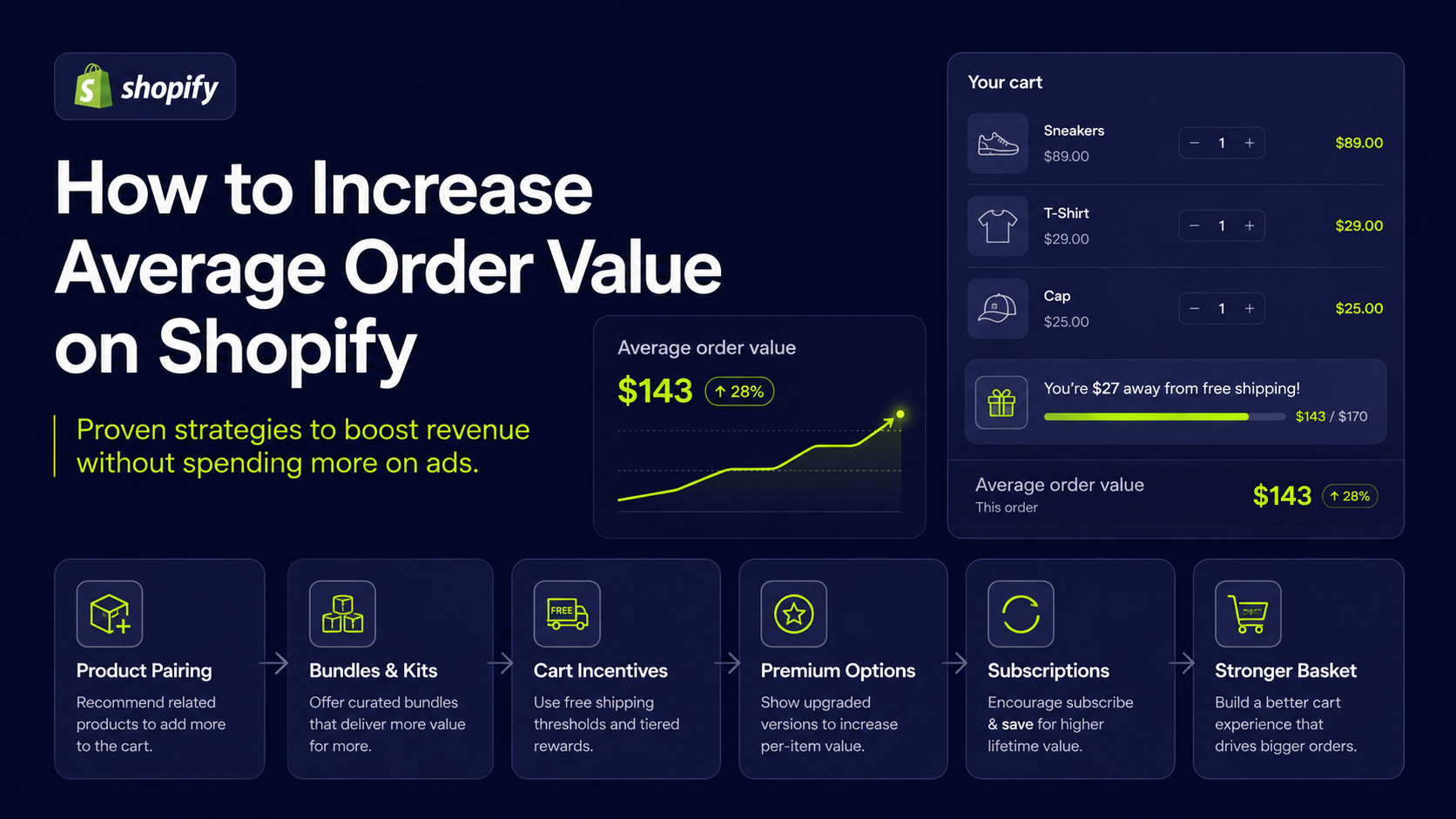
A lot of Shopify brands try to grow revenue by pouring more budget into traffic or squeezing out a slightly better conversion rate. Those levers matter. But in many stores, one of the fastest ways to improve performance is to increase average order value (AOV) — the revenue you earn every time someone checks out.
When your store makes it easy and natural for customers to:
- Add relevant complementary products
- Choose stronger offers
- Build more valuable baskets without friction
…you can grow revenue without relying only on more acquisition.
In this guide, we’ll look at how to increase average order value on Shopify in a way that supports conversion instead of hurting it. We’ll treat AOV as part of your broader CRO strategy, not a set of random widgets.
If you’d rather have a partner map this out for you, our Shopify CRO agency focuses on exactly this: turning existing traffic into more revenue through smarter UX, merchandising, and testing.
Why Average Order Value Matters on Shopify
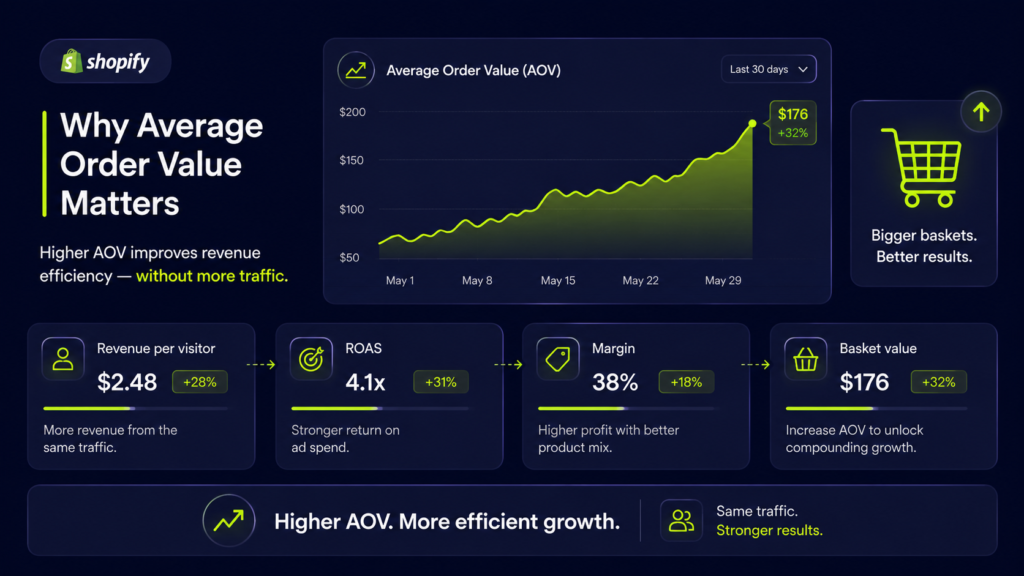
Average order value is more than a vanity metric. It directly shapes how efficiently your store turns traffic into revenue.
When AOV goes up and the conversion rate stays stable, a few important things happen:
- Revenue per visitor increases. Each session becomes more valuable, so the same traffic produces more revenue.
- Paid acquisition becomes more forgiving. Higher AOV improves your return on ad spend (ROAS) and gives you more room to compete in auctions.
- You’re less dependent on cheap traffic. If you can earn more per order, you don’t need traffic costs to stay low to stay profitable.
- You unlock budget for better experiences. More margin per order makes it easier to reinvest in better content, UX, and service.
In many Shopify stores, we see two common patterns:
- Traffic is stable or even growing, but revenue feels stuck.
- Conversion rate is acceptable, but the average basket is underweight relative to product economics.
In those cases, pushing harder on traffic can be the most expensive way to grow. Improving AOV is often faster, cheaper, and better aligned with long‑term unit economics.
The key is to grow AOV in a way that supports decision-making and trust. If you inflate baskets with irrelevant upsells or confusing bundles, you may see short-term AOV lifts at the cost of conversion rate, customer satisfaction, and repeat purchases.
What a Good Shopify AOV Strategy Should Do
Before you add any widgets or launch new offers, it helps to define what “good” looks like.
A healthy AOV strategy should help customers:
- Discover relevant complementary products
- Understand why the larger order is better for them
- Feel that extra items make sense in their situation
- Move toward a better offer without extra friction
- Increase basket value without feeling pushed
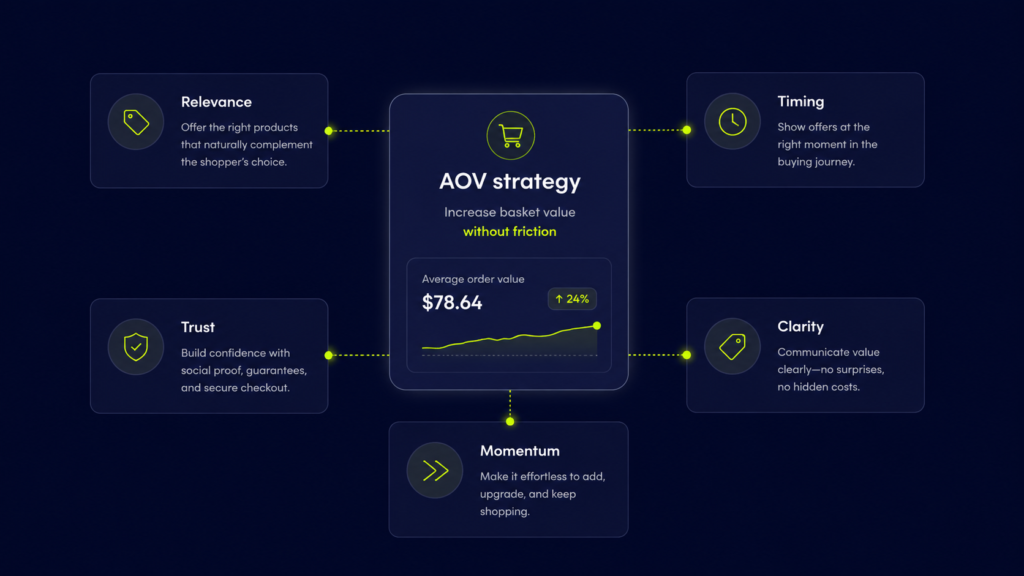
One good way to keep your tactics honest is to review every AOV idea through five lenses:
- Relevance Does this offer clearly fit the product, use case, and customer context? Or does it feel random?
- Timing Is the offer shown at a moment when the shopper still has mental bandwidth to consider it? Or is it interrupting a critical decision step?
- Clarity Can shoppers quickly understand what they get, how it works, and what it costs? Or do they need to pause and decode the offer?
- Trust Does the AOV tactic reinforce confidence (e.g., clearly better value, logical bundle)? Or does it signal that the store is trying too hard to extract more money?
- Momentum Does the offer keep the purchase moving forward? Or does it create new decisions and friction that slow people down?
If an idea scores poorly on any of these five, it’s likely to backfire — even if it looks clever in a tool demo.
Start with Product Pairing and Offer Relevance
Most underperforming AOV setups don’t fail because of a missing app. They fail because there’s no clear logic behind which products get paired and why.
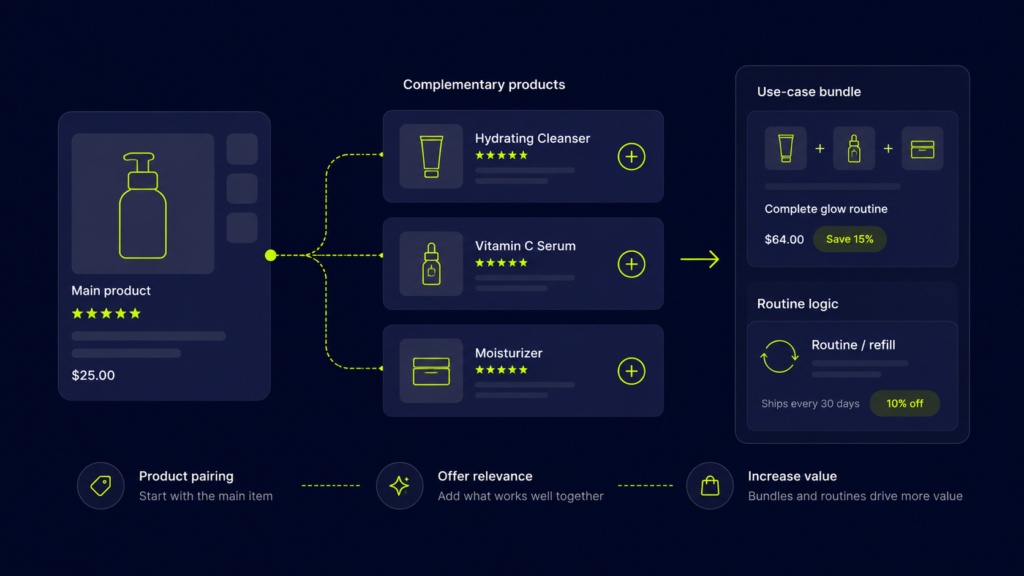
Complementary products
The simplest and strongest AOV wins often come from complementary products:
- A brush or cleanser with skincare
- A charger or case with electronics
- A belt with trousers
- A refill pack with a consumable
The key is that the next item should feel obviously useful in the context of the primary product. If shoppers have to think, “Why is this here?” you’re adding noise, not value.
Practical checks:
- For each hero product, list 3–5 genuinely helpful complements.
- Sense‑check the list with someone who knows the category (or real customers).
- Use those curated relationships to power your “You may also like” or “Complete the set” blocks, rather than relying on generic “related products” rules.
Use‑case bundles
Another strong pattern is to build bundles around specific use cases, not just “more of the same”:
- “Complete skincare routine for dry skin”
- “Starter kit for home espresso”
- “Weekend trip essentials”
- “Desk setup for remote work”
When bundles are framed around a job the customer is trying to get done, the higher basket feels natural and smart, not like an upsell trick.
Routine or collection logic
For repeat‑purchase categories (supplements, grooming, household supplies, etc.), consider routine logic:
- Three‑month supplies
- Refill packs that match usage patterns
- Collections that cover a full routine
This works especially well when you clearly explain:
- How long the bundle will last
- How it fits into daily or weekly habits
- Why this configuration is more efficient than buying items piecemeal
Why relevance beats aggression
It’s tempting to show as many offers as possible: carousels, popups, bundles, cross‑sells, badges.
In practice, one or two highly relevant offers nearly always outperform a dozen random ones — and they do it without increasing cognitive load.
If you’re not sure where to start, audit your current AOV tactics and ruthlessly remove anything that doesn’t pass the relevance test. Often, cleaning up noise is the first step toward meaningful AOV growth.
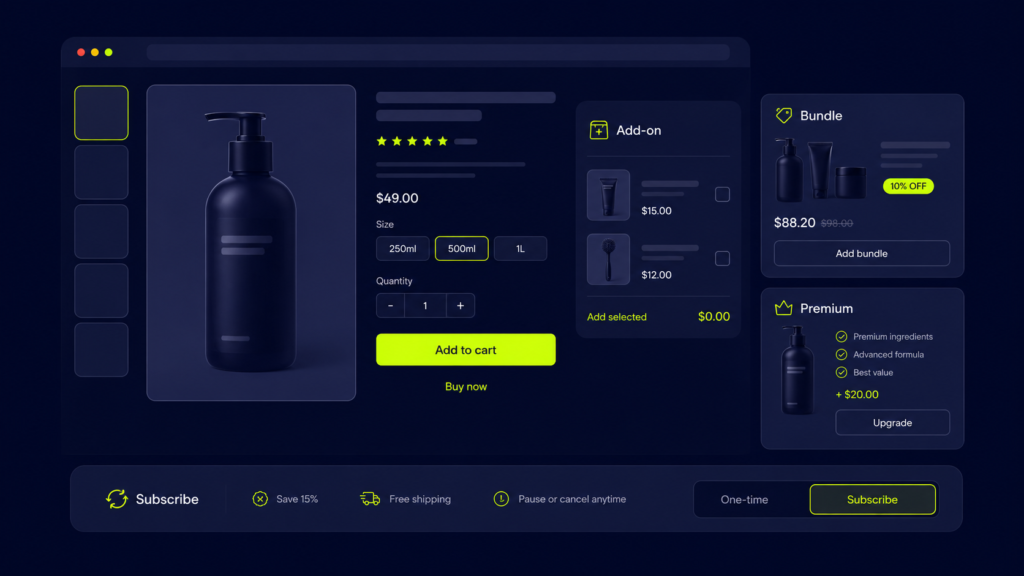
Improve Product Page AOV Opportunities
Product detail pages (PDPs) are one of the earliest and most powerful places to influence order value — if you do it in a way that supports the main purchase decision.
Add‑ons that make sense
Look for small, high‑margin add‑ons that genuinely improve the experience:
- Care products that extend product life
- Accessories that unlock new use cases
- Setup or assembly help for more complex items
Place these close to the main “Add to cart” area, with simple copy like:
- “Most customers also add…”
- “Protect your purchase with…”
- “Complete your setup with…”
The goal is to help shoppers feel more confident about the main purchase, not to distract them away from it.
Bundle framing on product pages
Where bundles are relevant, PDPs are a good place to introduce:
- “Buy the set & save X%”
- “Starter kit vs single item”
- “Good / Better / Best” bundles
Two important rules:
- Keep comparison simple. Use clear cards that show what’s included, key benefits, and price differences.
- Keep the primary CTA obvious. Shoppers should still be able to buy the single product without feeling lost.
Premium option positioning
Sometimes AOV grows not because customers add more items, but because they choose a more suitable, higher‑value version of what they already planned to buy.
On PDPs, that can look like:
- A premium material version
- A larger size that offers better value per unit
- A more complete kit with better long‑term economics
Use quick comparison points (bullets or tables) to justify the upgrade:
- “Includes X and Y that the base version doesn’t”
- “Better for [use case] because…”
- “Most customers who [situation] choose this option”
Subscription prompts where relevant
If you offer subscriptions or refills, PDPs are often where the decision starts.
Keep subscription prompts:
- Clearly differentiated from one‑time purchases
- Transparent about price, cadence, and cancellation
- Framed around convenience and reliability, not lock‑in
For stores heavily focused on subscriptions, you can link from these sections to deeper content like “How to Run a Shopify CRO Audit” or “Shopify CRO Audit Checklist” when you discuss how subscriptions impact overall revenue efficiency.
Use Cart‑Level Incentives Carefully
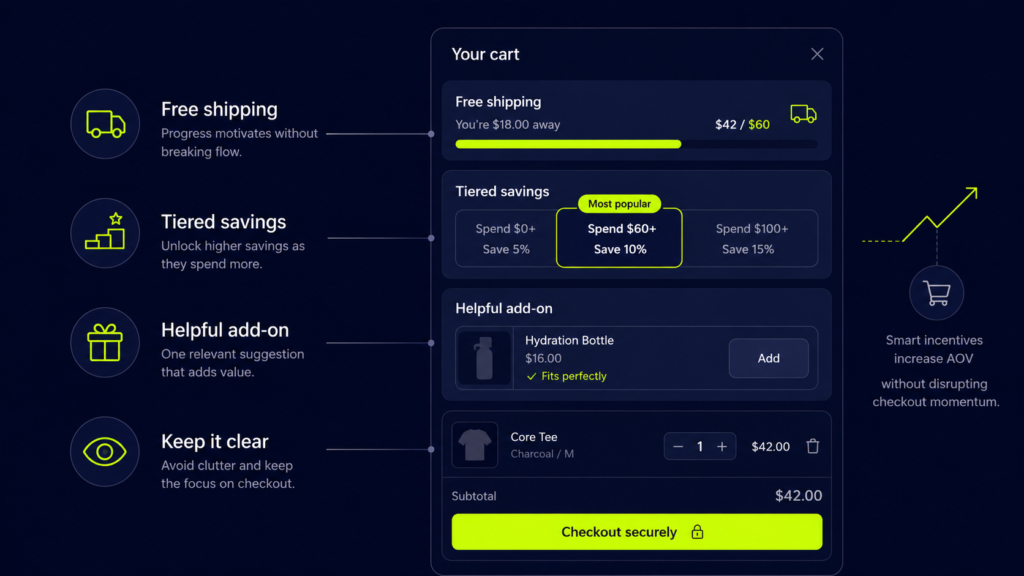
Cart is where momentum is highest and attention is lowest. Cart‑level incentives can lift AOV — but they can just as easily slow people down.
Free shipping thresholds
Free shipping thresholds are a classic AOV tool, and they still work when:
- The threshold feels reachable based on typical baskets
- The benefit is clearly communicated (e.g., “You’re $8 away from free shipping”)
- The UI shows helpful suggestions that bridge the gap
If your threshold is unrealistically high, shoppers read it as a pure promotion tactic and ignore it.
Spend‑more‑to‑save logic
Tiered discounts (“Spend $X, get Y% off”) can work when they make purchasing more efficient:
- “Spend $100, get 10% off — ideal for stocking up”
- “Buy 3, save 15% on your routine staples”
Keep in mind:
- Too many tiers confuse people.
- The math should feel fair and straightforward.
- The copy should emphasize value and practicality, not urgency for its own sake.
Relevant add‑ons in cart
Cart is often a good place to surface one last, highly relevant add‑on:
- Gift wrapping
- A travel case
- A refill that matches items in the basket
Treat this like a final check: “Do you also need…?”
Avoid turning the cart into a second product listing page.
When cart incentives become too aggressive
You know you’ve gone too far when:
- Cart feels visually crowded with promotions and modules.
- Important information (prices, totals, shipping) is hard to scan.
- Shoppers need to scroll a lot just to find the main CTA.
If your AOV tactics add more cognitive load than value at this stage, they’re likely hurting conversion rate more than they help revenue.
For deeper work on cart and checkout UX, this article should connect to your broader Shopify Cart and Checkout Optimization Guide and to your conversion optimization services.
Bundles Can Increase AOV — But Only If They Are Easy to Understand
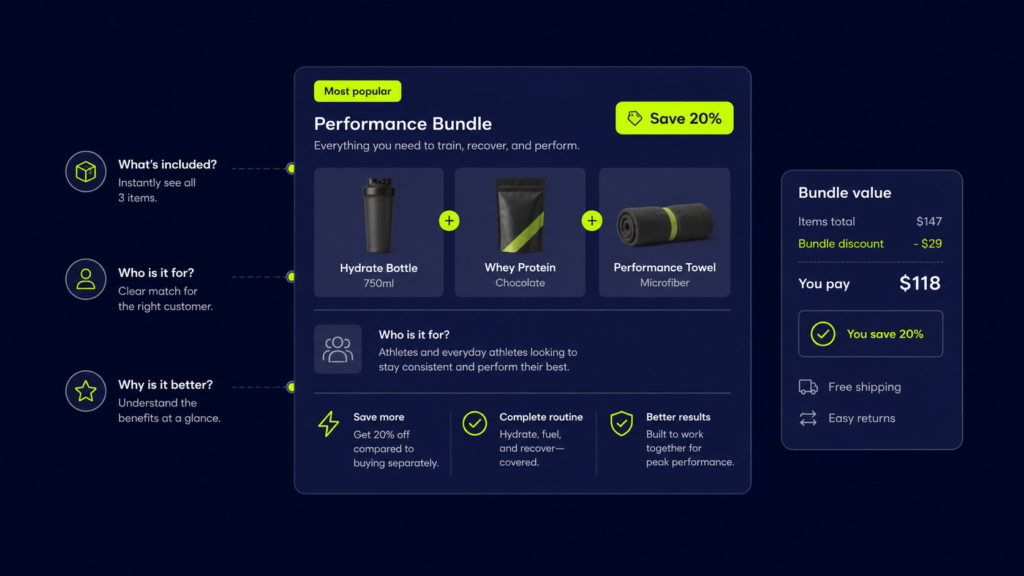
Bundles are one of the most common AOV levers, and also one of the easiest to get wrong.
Bundle clarity
Good bundles answer three questions instantly:
- What exactly do I get?
- Who is this bundle for?
- How is this better than buying separately?
Use simple naming and short descriptions:
- “Essential skincare routine for dry skin — Cleanser + Serum + Moisturizer”
- “Home bar starter kit — Shaker, Jigger, Strainer, Spoon”
Avoid vague labels like “Value bundle” without clear context.
Savings communication
If a bundle includes a discount, be explicit:
- “Save 15% vs buying individually”
- “Equivalent to 2 months free over the year”
Show both bundle price and per‑item or per‑use economics where it helps justify the decision.
Use‑case or routine bundles
Tie bundles to situations, not just product categories:
- “First‑time customers often start with…”
- “Everything you need for a 4‑week program”
- “The full setup we use in our own studio”
This framing makes the larger order feel like the smart, low‑effort choice.
When bundles feel forced
Bundles backfire when:
- Items don’t clearly belong together.
- The discount is so small it feels like a trick.
- The bundle makes choosing the right product harder, not easier.
If you see high bundle impressions but poor uptake, check clarity and relevance before assuming you need more aggressive discounts.
Cross‑Sells Work Best When They Reduce Effort
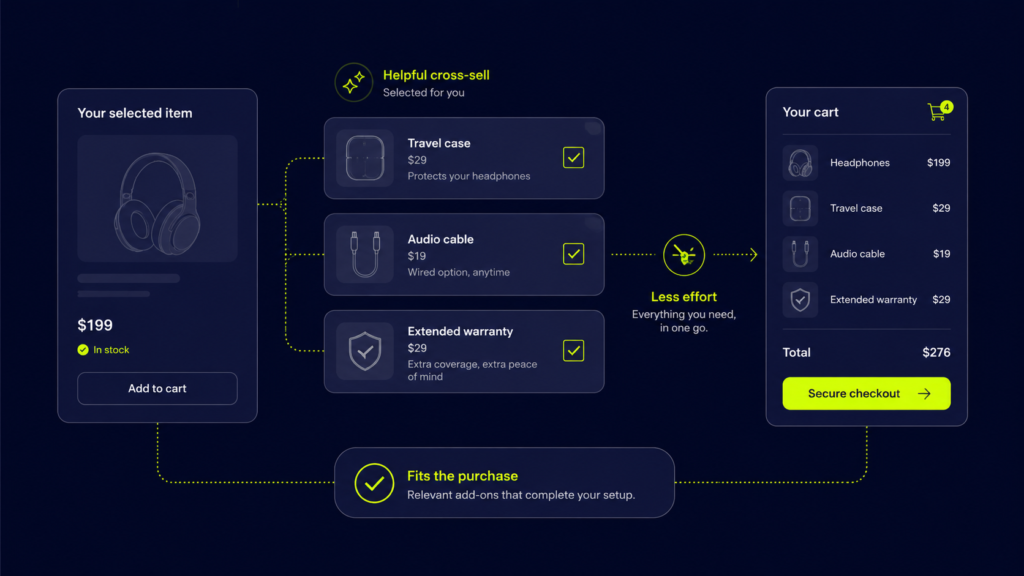
Cross‑sells should feel like a helpful assistant, not a loud sales rep.
Well‑designed cross‑sells:
- Anticipate what the customer will realize they need later.
- Remove a future errand or decision.
- Fit naturally with the primary product.
Examples:
- “Add a refill now so you don’t run out next month.”
- “Add the care kit that keeps this looking new.”
- “Add the cable you’ll need to connect this to your laptop.”
Keep in mind:
- Fewer, smarter cross‑sells almost always beat long, generic carousels.
- Placement matters — product pages, cart, and post‑purchase upsell pages each have different attention levels and expectations.
- The more complex the main purchase, the simpler cross‑sells should be.
When cross‑sells are tuned to convenience and context, they lift AOV while making the experience feel premium.
Premium Alternatives and Better‑Better‑Best Framing
Not every AOV gain needs to come from adding more items. Sometimes the best move is to help customers choose a better‑fit, higher‑value product.
Tiered offer framing
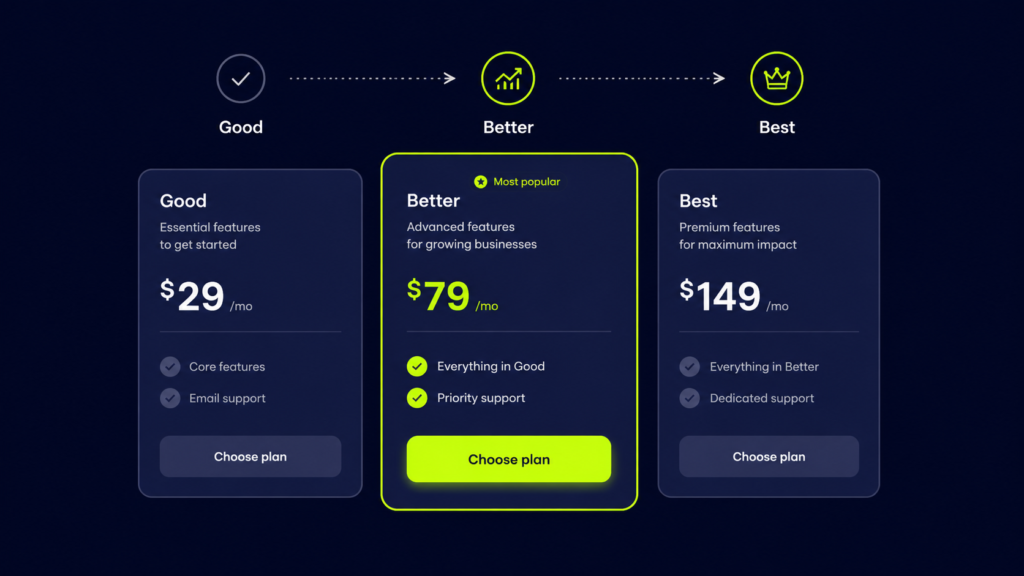
A classic structure is “Good / Better / Best”:
- Good: entry‑level, solves the core problem.
- Better: adds meaningful benefits for a reasonable price step.
- Best: comprehensive solution for heavy users or those who value quality most.
For this to work:
- Each tier must have a clear, honest reason to exist.
- The price gaps must feel proportionate to the added value.
- It should be obvious which tier is for whom.
Premium alternative logic
Common levers for premium alternatives:
- Better materials or ingredients
- Longer warranties or support
- Higher capacity or performance
- Bundled services (e.g., onboarding, installation)
Your job is to explain the logic, not just mark one option as “Recommended”.
Value‑based comparison
Instead of focusing only on price, show how premium options change outcomes:
- “Designed to last X times longer”
- “Covers your full routine instead of a single step”
- “Better for [specific use case] because…”
Many shoppers are willing to pay more when they understand how that choice aligns with their goals.
When upgrade paths feel useful
Upgrade paths feel right when:
- The shopper thinks, “Yes, that’s actually what I need.”
- The comparison reduces doubt instead of increasing it.
- The premium option is clearly optional, not forced.
Used well, this type of merchandising can increase AOV, reduce returns and support issues.
Subscription, Refill, and Repeat‑Purchase Opportunities
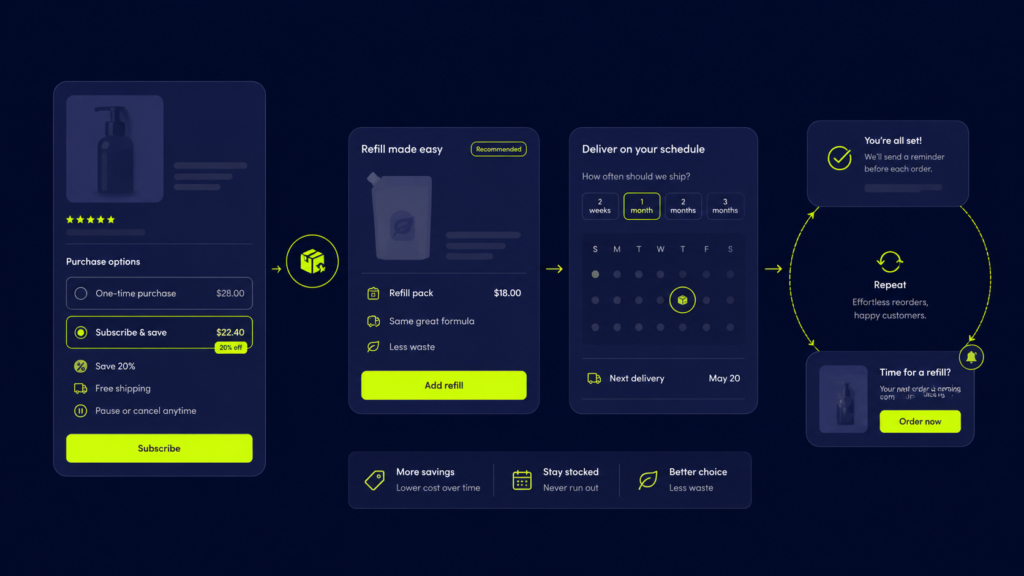
For some Shopify stores, AOV and lifetime value are tightly linked to repeat behavior.
Subscriptions and refills can improve order economics when they are:
- Offered for products people naturally rebuy
- Clearly explained (cadence, control, cancellation)
- Framed as a convenience, not a trap
Practical ideas:
- Let shoppers choose between one‑time and subscription on PDPs, with a short note on who usually subscribes and why.
- Offer modest, honest subscription incentives (e.g., small discount, free shipping, priority access) that make long‑term sense for your margins.
- Use post‑purchase flows to introduce subscriptions once customers have experienced the product.
For non‑subscription brands, simple refill reminders and multi‑pack options can still play a role in your overall AOV and revenue strategy.
Improve Merchandising Clarity Across the Store
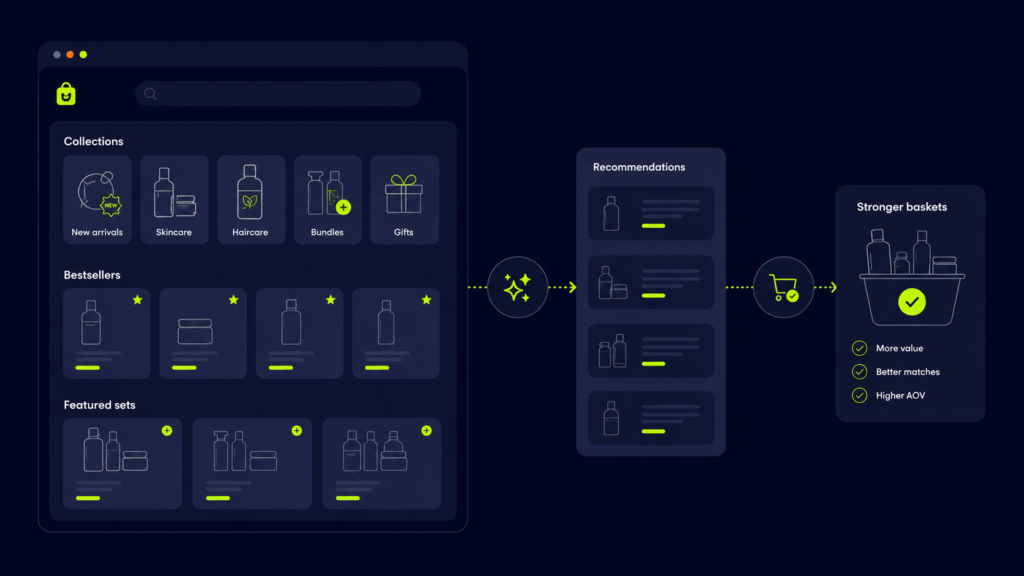
Some of the best AOV lifts come not from new offers, but from cleaner merchandising.
Ask yourself:
- Do your collections clearly group products by how customers shop (use case, problem, routine, level) — or mostly by internal categories?
- Are your bestsellers and high‑value bundles easy to discover from the homepage and main collections?
- Do recommendation blocks across the site feel coherent, or random?
Areas to review:
Collection logic
Make sure collections mirror how customers think:
- “Build your skincare routine”
- “Work‑from‑home essentials”
- “Travel‑friendly sets”
This makes it easier for shoppers to build bigger, more coherent baskets.
Recommendation placement
Use recommendation units strategically:
- On PDPs, to support the main product (complements, alternatives).
- In collections, to surface higher‑value or best‑selling configurations.
- In cart, to add the one or two most helpful final items.
Bestsellers and featured sets
Highlight:
- Bestselling bundles
- Curated sets with strong economics
- Proven “starter” or “upgrade” configurations
These give less decisive shoppers an easy, low‑risk way to build a better basket.
Overall, think of merchandising as guiding people toward better versions of the order they already wanted to place.
Common AOV Mistakes That Hurt Conversion
Not every AOV lift is worth it. Some tactics erode trust and conversion so much that they reduce net revenue.
Watch out for:
- Irrelevant upsells. “Weird” suggestions that feel algorithmic or purely margin‑driven.
- Confusing bundles. Too many items, vague savings, unclear differences between configurations.
- Overloaded carts. Too many incentives, badges, popups, and cross‑sells competing for attention.
- Excessive discounting. Training customers to wait for thresholds or bigger promotions instead of buying when they’re ready.
- Choice overload. Adding options and offers faster than you add clarity.
- Slowing the purchase. Any AOV tactic that significantly lengthens the decision process.
A simple gut check: if you feel slightly stressed using your own store on mobile with a slow network, customers will feel worse.
A Simple Shopify AOV Optimization Checklist
Use this checklist as a quick review of your current setup:
- Are complementary products relevant and easy to understand?
- Do product pages support natural add‑ons or bundles without overwhelming the core decision?
- Are cart incentives (free shipping, tiered discounts) clear, realistic, and easy to scan?
- Do bundles make sense at a glance, with obvious value and use cases?
- Are cross‑sells helping customers complete their purchase, or distracting them with noise?
- Are premium options framed clearly, with honest reasons to upgrade?
- Does the store guide users toward better baskets naturally through collections and recommendations?
- Do AOV tactics preserve purchase momentum, especially on mobile?
- Are merchandising opportunities (bestsellers, high‑value sets, starter kits) prominent enough?
- Is order value growth happening without harming conversion rate or customer trust?
For a deeper, structured review of your whole store, you can pair this with a broader Shopify CRO audit using resources like a Shopify CRO Audit Checklist or a How to Analyze a Shopify Conversion Funnel guide.
How to Prioritize AOV Improvements
Most teams have more ideas than implementation capacity. To avoid random experiments, group potential AOV changes by both impact and risk to conversion.
A simple way to prioritize:
Fix now: obvious missed opportunities
- Highly relevant cross‑sells that are missing or buried.
- Bundles that are already popular but poorly messaged.
- Confusing or noisy cart incentives that create friction.
These are usually low‑risk, medium‑to‑high impact.
Test next: promising ideas that need validation
- New bundle structures and naming.
- Alternative free shipping thresholds.
- New premium tiers or kit configurations.
Here, designing proper tests and measurement is as important as the idea itself.
Refine later: useful but less urgent enhancements
- More advanced merchandising logic.
- Additional collection types and landing pages.
- Deeper integration between AOV tactics and loyalty or referral programs.
As you work through this list, remember that AOV changes should be evaluated on both AOV movement and their effect on conversion rate and repeat behavior.
Final Thoughts – Stronger AOV Should Feel Natural
The best way to increase average order value on Shopify is not to force bigger baskets. It’s to make better orders feel like the obvious choice.
When you:
- Improve product pairing and bundle relevance
- Use PDPs and carts to support, not interrupt, decisions
- Keep bundles and cross‑sells clear and convenient
- Offer premium paths that are honestly better fits
- Clean up merchandising so stronger baskets emerge naturally
…AOV can grow in a way that supports both revenue and customer confidence.
If you’d like help identifying the right AOV opportunities across product pages, cart flow, bundles, and merchandising, our Shopify CRO agency and conversion optimization services are built to do exactly that — without hurting the conversion rate you’ve already worked hard to earn.