
A/B Testing Benchmarks for eCommerce: What a Good Win Rate Actually Looks Like
Many eCommerce brands invest time and money into A/B testing, expecting every experiment to deliver a big jump in sales. But that’s not how testing actually works, and once you understand the real benchmarks, your entire approach to optimization changes. Not every test wins. In fact, most successful testing programs expect the majority of experiments […]
Many eCommerce brands invest time and money into A/B testing, expecting every experiment to deliver a big jump in sales. But that’s not how testing actually works, and once you understand the real benchmarks, your entire approach to optimization changes.
Not every test wins. In fact, most successful testing programs expect the majority of experiments to either fail or produce no clear result at all. That’s not a sign of a broken program. It’s how smart optimization works.
So what does a good A/B testing win rate actually look like? The answer depends on how mature your testing program is, how much customer research you do before running experiments, and which parts of your store you’re testing. In this guide, we break down real-world benchmarks, explain why losing tests aren’t always bad, and show how successful eCommerce brands improve their results over time.
What Is an A/B Testing Win Rate?
A/B testing compares two versions of a page, element, or feature to see which one performs better. It’s a core part of Shopify conversion optimization and helps businesses make decisions based on real customer behavior rather than gut feeling.
A test is considered a “win” when the new version produces better results than the original, and the data confirms that improvement is reliable, not just a coincidence. A product page variation that increases purchases by 15%, a checkout flow that reduces abandonment, or a new call-to-action button that gets more clicks – those are all winning tests. Your win rate is simply the percentage of tests that produce a meaningful, confirmed improvement out of all the tests you run.
Average A/B Testing Win Rates Across eCommerce
One of the biggest misconceptions in eCommerce is that top brands win most of their tests. They don’t. Industry benchmarks consistently show that even advanced optimization teams deal with a large number of failed or inconclusive experiments.
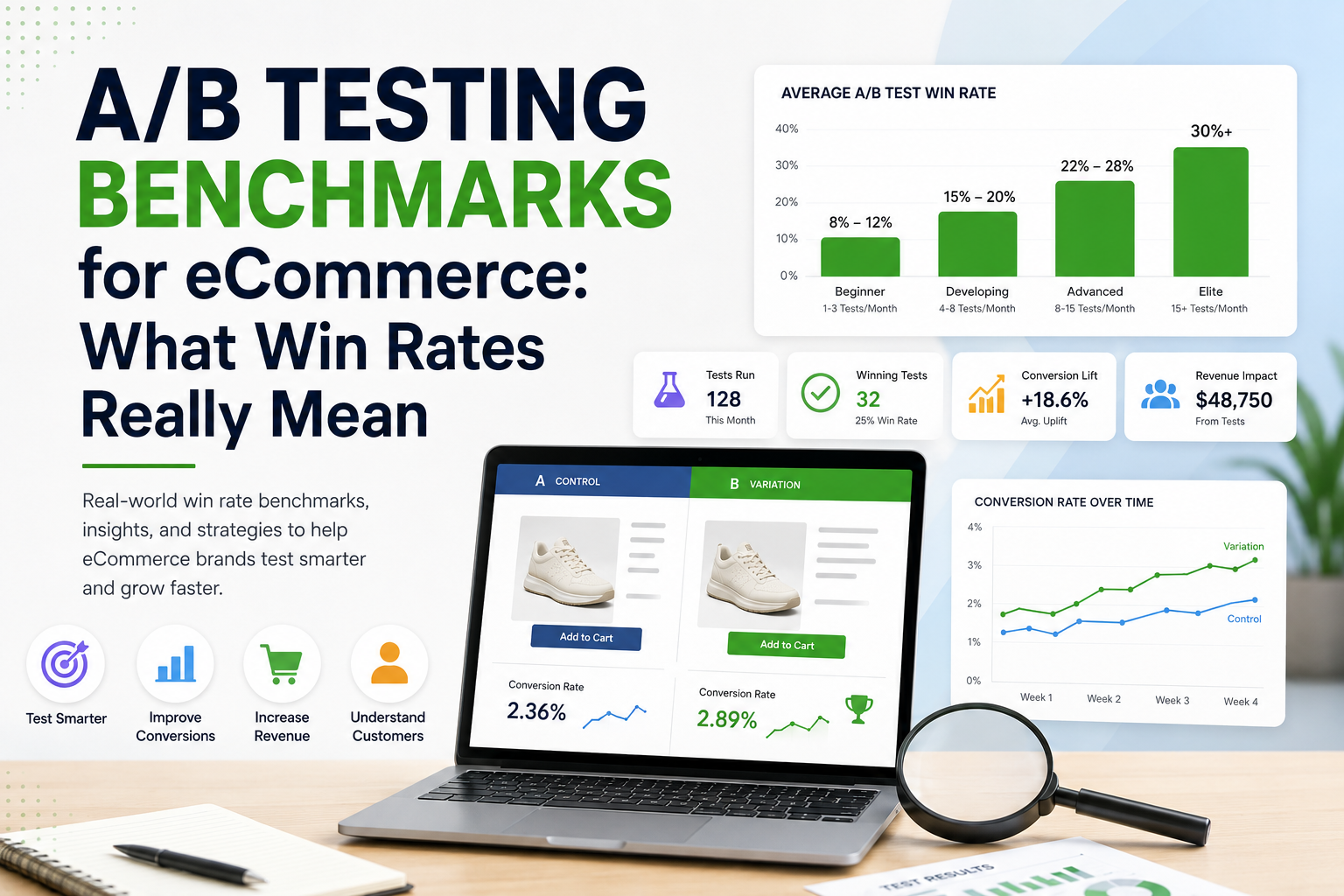
| Program Level | Tests Per Month | Average Win Rate |
| Beginner | 1-3 | 8%-12% |
| Developing | 4-8 | 15%-20% |
| Advanced | 8-15 | 22%-28% |
| Elite | 15+ | 30%+ |
At first glance, a 30% win rate may seem lower than expected. Many store owners assume successful testing programs win most of their experiments, but that is rarely the case. The strongest optimization teams focus less on winning every test and more on understanding customer behavior. Each experiment provides insights that help improve future decisions, which is why even unsuccessful tests can contribute to long-term growth.
Why Most A/B Tests Don’t Produce Winning Results
One of the biggest misconceptions about A/B testing is that successful brands win the majority of their experiments. In reality, even mature optimization programs experience a large number of neutral or unsuccessful tests.
Industry studies consistently show that around 40% to 50% of experiments fail to produce a statistically significant winner. While that may sound discouraging, it is actually a normal part of the optimization process.
Every test provides useful information. A losing test may reveal that customers don’t respond to a particular message, design change, or offer. A neutral result can indicate that a page element has less influence on buying behavior than expected.
Rather than viewing unsuccessful tests as failures, experienced optimization teams treat them as learning opportunities. The goal isn’t to win every experiment. The goal is to understand customer behavior and use those insights to improve future decisions.
What Conversion Lift Should You Expect?
A winning test does not need to produce dramatic results to be valuable. In reality, most successful experiments generate moderate improvements that compound over time. The size of the uplift often depends on the page being tested, the amount of traffic it receives, and how closely the experiment addresses a real customer pain point. Several small gains across product pages, cart pages, and checkout flows can have a larger impact than a single high-profile test.
Product Pages
Product pages are often among the best places to test because visitors reaching these pages are already evaluating a potential purchase. Small improvements to product information, reviews, pricing, or trust signals can influence buying decisions and create measurable gains in conversion rates.
Typical improvements range from:
- 12% to 28% conversion growth
Common testing opportunities include:
- Product images
- Product descriptions
- Customer reviews
- Trust signals
- Shipping information
- Call-to-action buttons
Small adjustments can make a noticeable difference when thousands of visitors view these pages each month.
Checkout Pages
Checkout optimization often produces strong results because shoppers are already close to purchasing. Many brands use a detailed Shopify CRO checklist to identify checkout issues that may be preventing customers from completing their purchases.
Typical improvements range from:
- 8% to 25% higher completion rates
Popular checkout experiments include:
- Simplified forms
- Faster checkout flow
- Payment method placement
- Trust badges
- Guest checkout options
Cart and Mini-Cart Improvements
Cart-level optimizations usually produce smaller individual gains, typically between 1% and 5% in conversion increases, but they also tend to lift average order value and improve overall cart engagement. When combined with wins on product and checkout pages, these smaller improvements can produce meaningful revenue growth over time.
The Biggest Factors That Influence Win Rates
Not all testing programs achieve the same results. A few key factors make a significant difference.
1. Customer Research: The best tests start with research, not guesswork. Before launching any experiment, strong optimization teams study customer behavior through heatmaps, session recordings, on-site surveys, analytics data, and direct customer feedback. Research helps pinpoint real problems rather than testing ideas based on what feels right.
2. Traffic Volume: Reliable A/B testing requires enough visitors to produce statistically meaningful results. Small sample sizes often lead to misleading conclusions. The more data you have before calling a winner, the more confident you can be in the outcome.
3. Testing High-Intent Pages: Some pages have a much greater impact on revenue than others. Product pages, collection pages, cart pages, and checkout pages are directly tied to purchase decisions, which makes them the highest-priority areas for testing.
4. Test Quality: A strong hypothesis makes a big difference. Testing a button color because it seems like a good idea is very different from testing a change that’s backed by actual user behavior data. Research-backed ideas consistently outperform guesswork.
Why Product Pages Are Often the Best Place to Start
Many eCommerce businesses begin testing homepage designs because the homepage feels like the center of the store. In reality, product pages often deliver greater value because visitors on these pages are already closer to making a purchase. They are comparing details, checking reviews, looking at price, and deciding whether the product feels worth buying. That makes product pages one of the strongest places to start when improving conversion performance.
Testing opportunities include:
- Product image layouts
- Review placement
- Product benefits
- Pricing presentation
- Shipping details
- Return policy visibility
Even small improvements can increase trust and reduce hesitation. For businesses focused on eCommerce conversion optimization, product pages often provide some of the fastest wins.
How Successful eCommerce Brands Improve Win Rates
The highest-performing eCommerce brands don’t rely on guesswork when running A/B tests. Instead, they follow a structured process that helps them identify high-impact opportunities before launching experiments.
Most successful testing programs begin with research. Teams analyze Shopify conversion funnels to identify where shoppers drop off before completing a purchase. This allows them to develop hypotheses based on real user behavior rather than assumptions.
They also focus their efforts on high-intent pages such as product pages, cart pages, and checkout flows, where even small improvements can have a direct impact on revenue. Rather than testing random design changes, they prioritize experiments that address specific customer concerns or obstacles in the buying journey.
Another common trait of successful brands is consistency. They treat A/B testing as an ongoing process rather than a one-time project. Each experiment provides insights that help improve future tests, leading to stronger hypotheses and better results over time.
Some of the practices commonly used by high-performing optimization teams include:
- Reviewing customer journey data before launching tests
- Using heatmaps and session recordings to identify friction points
- Prioritizing high-traffic, high-intent pages
- Creating research-backed testing hypotheses
- Running tests long enough to reach statistical significance
- Measuring revenue impact instead of focusing only on click-through rates
This research-first approach helps eliminate weak ideas before testing begins. As a result, winning experiments become more frequent, and the overall business impact of each test becomes much greater.
How Webspirit Approaches eCommerce Testing
Many Shopify businesses invest heavily in traffic generation through SEO, paid advertising, email campaigns, and social media. However, traffic growth alone does not always lead to higher revenue.
Successful conversion optimization starts with understanding how customers interact with your store. Reviewing user behavior, identifying friction points, and testing improvements based on real data often leads to better results than making design changes based on assumptions.
Webspirit works with Shopify brands across the USA to identify conversion barriers, improve customer journeys, and develop testing strategies focused on measurable business outcomes. From product page optimization and checkout improvements to mobile experience enhancements, every recommendation is backed by customer behavior and performance data.
Whether your goal is to increase conversions, improve average order value, or generate more revenue from existing traffic, a structured testing approach can uncover growth opportunities that are often overlooked.
Frequently Asked Questions
What is a good A/B testing win rate for eCommerce?
A strong eCommerce conversion optimization program often achieves a 20% to 30% win rate. Advanced teams may exceed this by using customer research and testing high-impact pages.
Why do many A/B tests end without a win?
Customer behavior is complex, which means not every change will have a measurable impact on conversions. Many experiments produce neutral results because the tested element was not a major source of friction. These findings are still valuable because they help eliminate weak ideas and guide future optimization efforts. Conducting a Shopify CRO audit before testing can help identify higher-impact opportunities and improve test outcomes.
How long should an A/B test run?
Split testing best practices recommend running experiments until enough traffic and conversions are collected. Ending tests too early can produce unreliable results and misleading conclusions.
What pages should I test first on an online store?
Product page optimization is often the best starting point because these pages influence buying decisions directly and usually receive significant traffic from interested shoppers.
Can A/B testing improve checkout conversions?
Yes. Checkout optimization can reduce friction, simplify forms, improve trust, and help more shoppers complete purchases, often leading to measurable increases in completed orders.
How can Shopify stores improve testing results?
Shopify conversion optimization works best when tests are based on analytics, customer feedback, session recordings, and clear hypotheses rather than assumptions or design preferences.
Final Thoughts
A good A/B testing win rate is not about winning every experiment. Most successful eCommerce brands expect some tests to fail, many to remain neutral, and a smaller percentage to deliver meaningful results. The real value comes from understanding customer behavior and using those insights to improve important areas of your store. When supported by a structured testing process, even small changes can lead to stronger conversions, higher revenue, and a better customer experience.
If your store is generating traffic but conversions are not growing as expected, it may be time to take a closer look at your customer journey. Testing key pages, identifying friction points, and making data-backed improvements can often uncover opportunities that drive meaningful results. If you’d like a fresh perspective on your Shopify store’s performance, feel free to contact the team at Webspirit to discuss your goals and explore potential areas for improvement.