
Shopify CRO vs Shopify SEO: Which Should Shopify Brands Prioritize First?
Many Shopify store owners face the same challenge. They want more sales but are unsure where to invest their time and budget. Should they focus on Shopify SEO to attract more visitors? Or should they invest in Shopify CRO to convert more of their existing traffic into customers? The answer depends on your store’s current […]
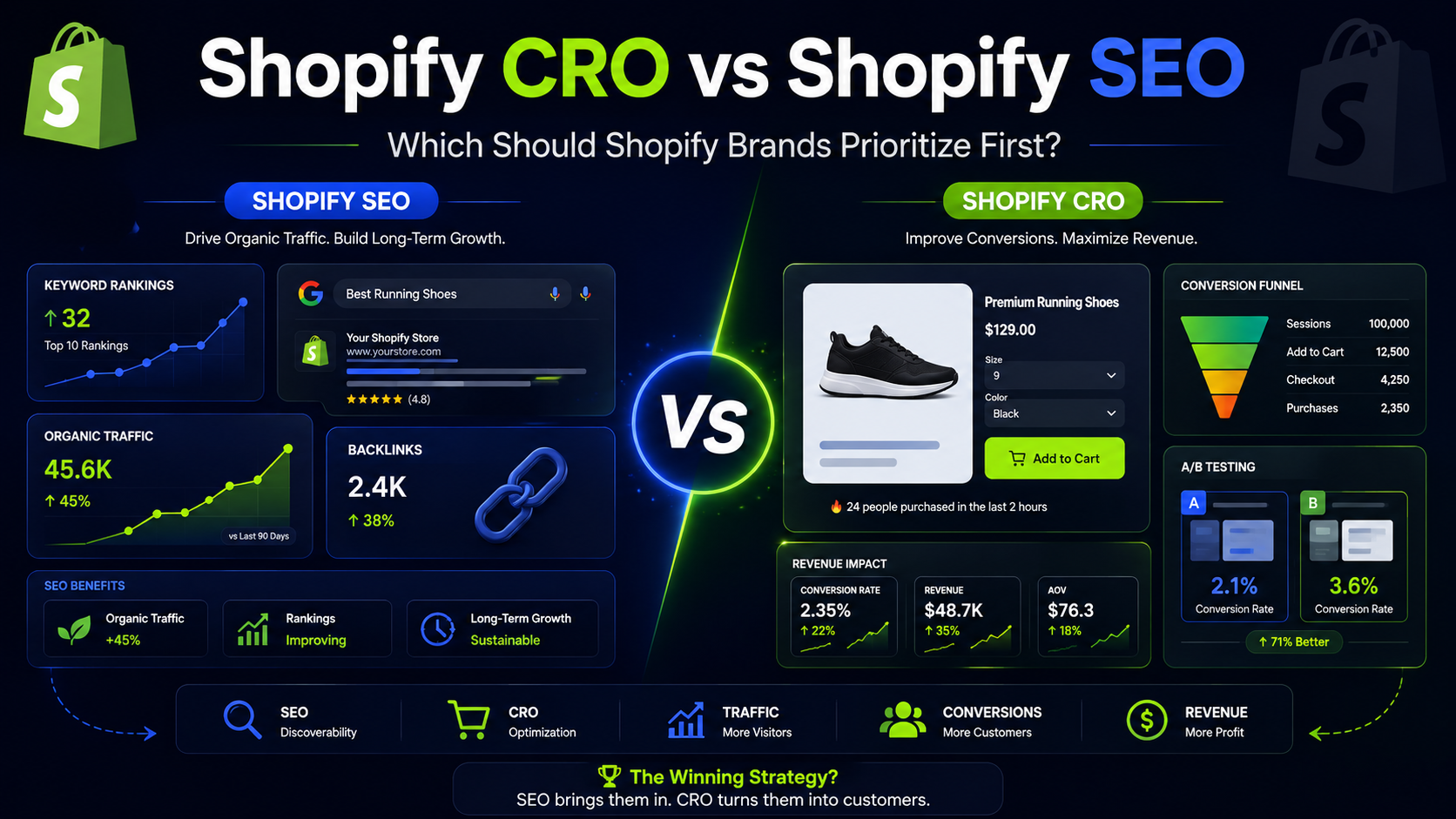
Many Shopify store owners face the same challenge. They want more sales but are unsure where to invest their time and budget.
Should they focus on Shopify SEO to attract more visitors? Or should they invest in Shopify CRO to convert more of their existing traffic into customers?
The answer depends on your store’s current situation. Both strategies play an important role in e-commerce growth, but the right starting point varies from one business to another.
In this guide, we’ll compare Shopify CRO vs Shopify SEO, explain how each strategy works, and help you decide which one should be your priority.
What Is Shopify SEO?
Shopify SEO is the process of improving your store’s visibility in search engines such as Google.
The goal is to increase organic traffic by helping your store rank for relevant search terms that potential customers are already searching for.
A typical Shopify SEO strategy may include:
- Keyword research
- Product page optimization
- Collection page optimization
- Technical SEO improvements
- Content marketing
- Internal linking
- Link building
Many brands choose Shopify SEO services to improve rankings and attract qualified visitors without relying entirely on paid advertising.
When done correctly, Shopify SEO can generate consistent traffic and support long term business growth.
What Is Shopify CRO?
Shopify CRO stands for Shopify Conversion Rate Optimization.
Instead of focusing on traffic, CRO focuses on turning more visitors into customers.
If 1,000 people visit your website each month and only a small percentage purchase, CRO helps improve that percentage.
A Shopify CRO strategy may include:
- Product page improvements
- Better navigation
- Mobile optimization
- Checkout improvements
- A/B testing
- User behavior analysis
- Trust building elements
The goal is simple. Increase sales without necessarily increasing traffic.
This is why many growing brands work with a Shopify CRO agency to improve their store performance and maximize conversions alongside SEO efforts.
Shopify SEO vs Shopify CRO: Understanding the Difference
Although both strategies support growth, they solve different problems.
Shopify SEO Helps You Get More Visitors
SEO focuses on increasing visibility in search engines.
Benefits of Shopify SEO include:
- More organic traffic
- Better search rankings
- Increased brand awareness
- Lower long term customer acquisition costs
- Consistent traffic growth
If your store struggles to attract visitors, SEO is often the first area to address.
Shopify CRO Helps You Generate More Sales
CRO focuses on improving the experience for visitors who already arrive at your store.
- It increases conversion rates by turning more visitors into customers
- It improves user experience, making shopping easier and more enjoyable
- It optimizes the customer journey from landing to checkout
- It increases revenue from existing traffic without needing more visitors
- It helps raise average order value through better on-site optimization
If your store receives traffic but sales remain low, CRO often delivers faster improvements.
When Should Shopify Brands Prioritize SEO First?
SEO should usually come first when your store has limited traffic.
If only a small number of people are visiting your website each month, improving conversion rates may have a limited impact because there are not enough visitors to optimize.
You should prioritize Shopify SEO if:
- Your organic traffic is low
- Your store does not rank for important keywords
- Competitors dominate search results
- You rely heavily on paid advertising
- You have little content on your website
A professional Shopify SEO services company in USA can help identify opportunities to improve visibility and attract qualified visitors.
Over time, increased search visibility creates a stronger foundation for growth.
When Should Shopify Brands Prioritize CRO First?
CRO should become the priority when your store already attracts traffic but struggles to convert visitors into customers.
Common signs include:
- High traffic but low sales
- High cart abandonment rates
- Low conversion rates
- Poor mobile performance
- Customer drop off during checkout
In these situations, increasing traffic alone may not solve the problem.
Improving the customer experience often delivers quicker revenue gains because it helps you get more value from existing visitors.
A detailed Shopify CRO audit checklist can help identify areas where customers encounter friction during the buying process.
The Best Growth Strategy Combines SEO and CRO
Many Shopify businesses view SEO and CRO as competing strategies.
In reality, they work best together. SEO brings qualified visitors to your website. CRO helps convert those visitors into customers.
For example:
- SEO increases monthly traffic from 5,000 visitors to 15,000 visitors.
- CRO improves conversion rates from 1.5% to 3%.
The combination creates significantly more sales than either strategy could achieve on its own.
This is why successful e-commerce brands invest in both traffic growth and conversion optimization.
Common Mistakes Shopify Brands Make
Many businesses delay growth because they focus too heavily on one area while ignoring the other.
Some common mistakes include:
- Investing in SEO without improving user experience
- Running ads to poorly optimized pages
- Ignoring technical SEO issues
- Failing to test product page layouts
- Overlooking mobile shopping experiences
- Neglecting checkout optimization
A balanced approach often produces the strongest long-term results.
How Webspirit Helps Shopify Brands Grow
Over the past many years, Webspirit has worked with Shopify businesses across multiple industries, helping improve organic visibility, user experience, and conversion performance through SEO and CRO strategies.
Our team combines:
- Shopify SEO services
- Technical SEO audits
- Shopify CRO services
- Conversion analysis
- Content optimization
- Store performance improvements
This allows businesses to build a stronger foundation for sustainable growth.
Whether you need help improving rankings or increasing conversions, the goal remains the same: helping your store generate more revenue.
Final Verdict: SEO First or CRO First?
The right answer depends on where your store is today.
Choose Shopify SEO first if your website struggles to attract visitors and generate organic traffic. Choose Shopify CRO first if your website already receives traffic but is not converting enough visitors into customers. For most established Shopify brands, the highest growth comes from combining both strategies. SEO helps attract the right audience, while CRO ensures more of those visitors become paying customers. Together, they create a growth system that supports long-term e-commerce success.
Frequently Asked Questions
1. What is the difference between Shopify SEO and Shopify CRO?
Shopify SEO focuses on increasing organic traffic through search engines, while Shopify CRO focuses on improving conversion rates and turning more visitors into customers.
2. Which delivers results faster, SEO or CRO?
CRO often delivers faster results because it improves performance from existing traffic. SEO usually takes longer but can generate sustainable traffic growth over time.
3. Can Shopify brands use SEO and CRO together?
Yes. SEO attracts visitors, while CRO improves conversions. Combining both strategies often produces better long term results than focusing on only one.
4. Is Shopify SEO worth it for new stores?
Yes. New stores often need more visibility and traffic. SEO can help attract potential customers and reduce dependence on paid advertising.
5. What does a Shopify CRO audit include?
A Shopify CRO audit reviews user behavior, navigation, product pages, checkout experience, and conversion barriers that may impact sales performance.